How districts are finally getting insights to the people who need them
Table of Contents
Districts have never had more data. Attendance systems, assessment platforms, behavior logs, grade books — all of it collected, stored, and technically “accessible.” Yet if you ask a teacher on a Tuesday afternoon which of her students is at risk of falling behind, the honest answer is usually a feeling, not a fact. The data exists. It just never made it to her.
That's the last mile problem.
K-12 has spent the last decade building bigger and better dashboards to connect educators with the data that alters student outcomes. But a dashboard that nobody opens isn't a solution — it's an expensive filing cabinet. The gap that actually costs students isn't in the data. It's in the final distance between the insight and the person who needs to act on it.
Here we’ll explore the three main barriers to data-informed cultures – and how districts are overcoming them to close the last mile.
Barrier #1: Access takes time and effort.
Teachers intuitively know that attendance, discipline, and demographic data have a lot to say about a student’s effectiveness in the classroom — mapping those relationships in the data is more daunting. From identifying the right data sources to setting the right filters, the complexity of accessing the data can quickly exhaust the little time teachers have for investigating it. When it comes to informing action in their PLC meetings, it’s faster and easier for educators to default to anecdotal evidence.
The solution: Scheduled deliveries of curated data
Anne McDonnell, Director of Student Services at Streator Elementary School District, learned how effective initiatives can be when educators are empowered with data at their fingertips. Using Homeroom tools from SchoolData, she set up attendance data sheets to be automatically generated and delivered to principals in a weekly email.
Distributions timed to arrive shortly before a standing meeting ensure that staff know ahead of time “what we’re going to discuss without having to search for that information.” McDonnell also appreciates that “it takes the emotion out” when teams are regularly reviewing the same data together – the focus stays on the shared goal of student impact. And that impact is felt: one of Streator’s schools soon saw a 30% increase in daily attendance.
The scheduled data distributions have now become “an integral part of the student decision-making process” for Streator.
Barrier #2: Dashboards were designed for analysts, not educators.
One reason that data access has been time-consuming for educators? The tools built for them weren’t actually built for them. Most dashboards were designed by people who love data, for people who love data. What looks like a powerful tool to a data coordinator can be an overwhelming (or paralyzing) interface for a third-grade teacher.
The solution: A built-in data analyst that educators can question in plain English
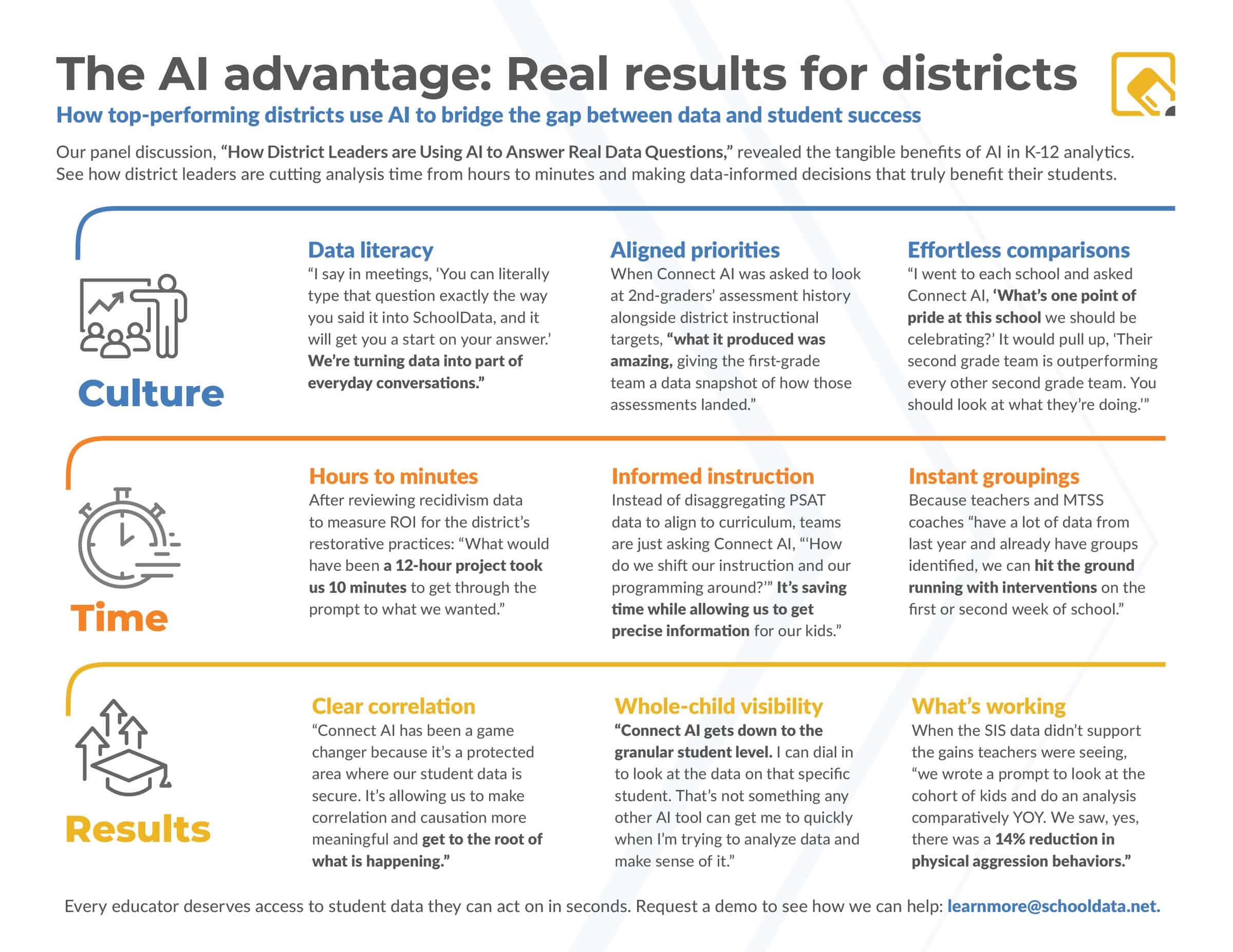
Once teachers have data delivered to their inbox, they’ll naturally have questions about the patterns they’re seeing, but may not know how to extract clearer answers. SchoolData’s digital analyst, Connect AI, allows them to engage with the data in a conversational way – no configuration required.
Even the most open-ended questions can be put to Connect AI to help educators in making data-informed decisions. Andy Langlois, Data Strategist Coordinator at DeKalb School District, describes how a new principal might “ask for priorities to focus on with my staff the next year,” including identifying needs of returning and incoming students and suggesting responsibilities that could be delegated. From there, the user could “drill into one priority and look for ways to coordinate with another building as students transitioned into 9th grade.”
Because it’s trained by educators and embedded in your district’s data, Connect AI anticipates your next steps, offering to create a student group, draft a parent communication, or prepare an audit-ready report. For psychologist Hayley Mesplie of Yakima School District, Connect AI generated graphs that “I was able to use in my reports and meetings” and maximize efficiency. “Something that used to take me about 20 minutes took me 2 minutes.”
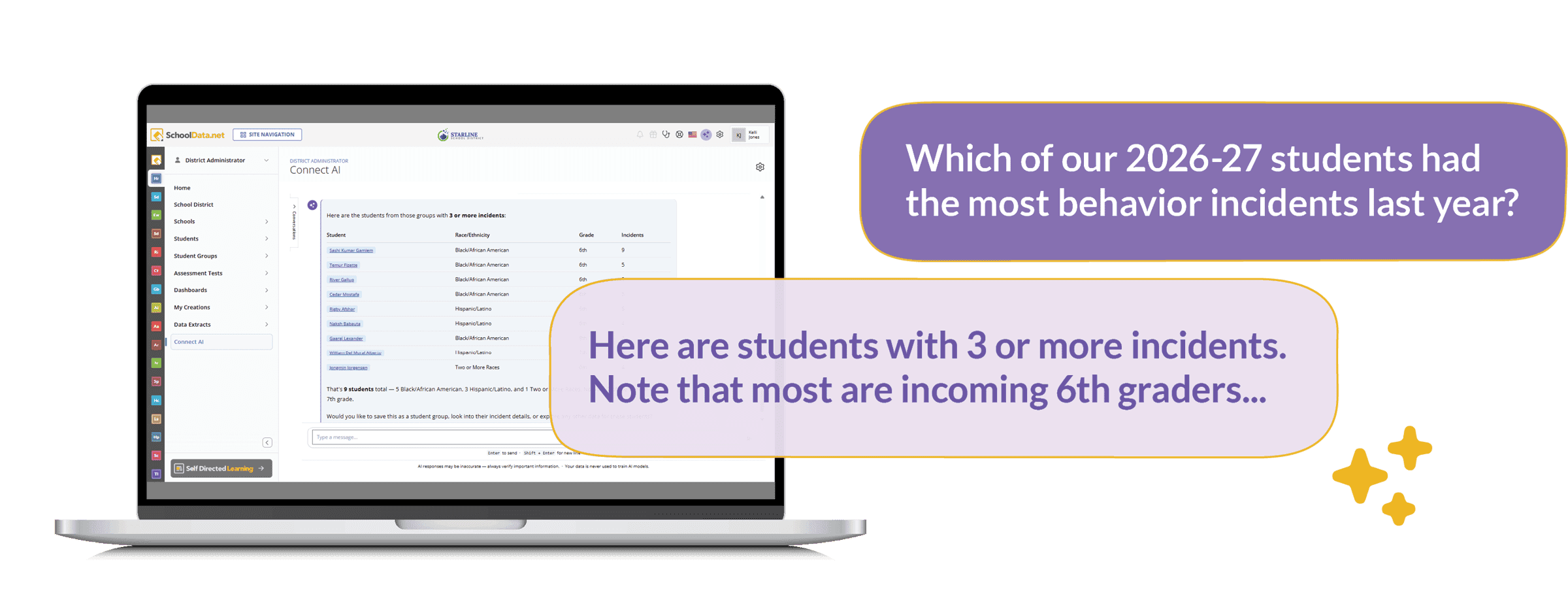 Educators can ask any question of their data and get answers and reasoning from Connect AI.
Barrier #3: Some critical data is available too late.
Most assessments don’t publish results until months after they’re administered. Other data, like which students are completing CTE coursework, can go un-published for years. But even if the data is just a week old, your window for meaningful action may have already closed. Late delivery turns the data that should empower teachers into a source of “if only” regrets.
The solution: Insights available immediately for right-now relevance
Nightly data downloads are key to keeping educators on top of every data development. Assessments are displayed as soon as preliminary results are released in Homeroom dashboards. And early warning alerts pop up based on criteria set months before, so no child falls through the cracks. .
Tiffany Gould, Executive Director of Teaching and Learning at Ridgefield School District, has noticed “a much bigger impact" when teachers have access to current data. Teachers can not only identify student needs faster, but they can also see progress in real time. Gould says fresh data has a strong influence on teachers’ “willingness to look at your practice and change" tactics where needed to foster student success.
Homeroom also allows administrators to create special one-off deliveries of data precisely when they’re needed. This just-in-time data provides a strong foundation for every decision point, like when you’re beginning a new school term, launching Highly Capable screening, or defending the ROI for a program’s budget.
Closing the gap
Your student data is full of stories your educators need to hear. The question isn't whether the insights exist. It's whether they're reaching the people who can do something about them. The districts getting it right are changing what's possible for students — not by collecting more data but by delivering it that last mile.
Homeroom Premium helps districts clear all their data-adoption barriers in a single platform. From custom data deliveries to instant analytics, educators get all the tools they need to make and defend the decisions that make the biggest impact on student outcomes.
Download our prompt guide to see how district leaders are already closing the last mile for their teams, or request a demo of the platform for your district.