When a question can be answered in the moment it’s asked, data stops being something done to educators and becomes something they use.
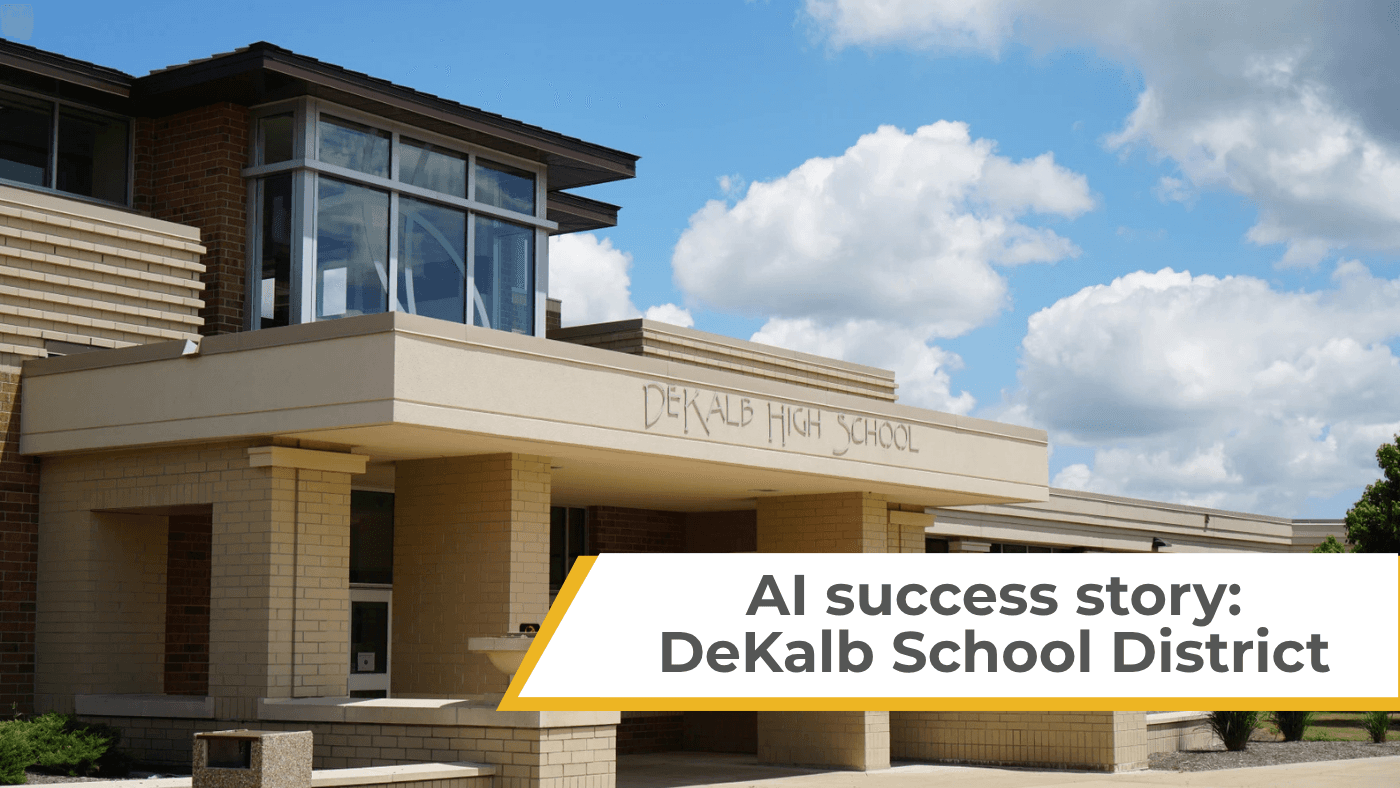
When Andy Langlois arrived at DeKalb Community Unit School District 428 five years ago, his role was brand new to the district. As the Data Strategist in the Innovation and Improvement department, he connects DeKalb’s strategic plan to school improvement plans and PLCs across 13 PreK–12 schools in northern Illinois, while also leading program evaluation and return-on-investment work. The first challenge he faced, though, wasn’t technical. He had to reframe data analysis in a culture that had become “evaluative,” he recalls. Data was “how we were measuring people, not learning and growth.”
Langlois set out to change that relationship. His goal was to make data “not the signposts but the landscape that you’re in” — to “socialize data so it no longer becomes deeply personal.” Shifting the culture meant helping building leaders develop their own “self-efficacy for data,” and Connect AI has become a key part of that strategy. Today, DeKalb staff are asking and answering their own questions, sometimes before Langlois even knows the question exists.
Prove what educators already see in their buildings
Sometimes the most valuable analysis confirms what staff already sense but can’t yet show. DeKalb’s restorative deans were preparing an Institute Day presentation on their restorative practices. From their daily work in the buildings, “they know that their restorative practices are working,” Langlois says. Yet when the deans pulled their numbers the traditional way, the raw counts showed more students receiving discipline referrals than the year before.
Langlois asked whether they had tried Connect AI. Together, they wrote a prompt that looked beyond simple counts to recidivism: how many students had a second offense after their first, compared with the same cohort the prior year, regardless of which building those students attended. After a few follow-up questions and refinements, the answer was clear. The analysis showed “a 14% reduction in physical aggression type behaviors,” giving the deans “a quantitative number” to back up their anecdotal data.
The time savings were just as striking. Building the same cohort comparison by hand would have required:
- Five separate discipline reports pulled across two buildings and multiple school years
- “A lot of VLOOKUPs, a lot of index matching” to identify the student cohorts
- A series of pivot tables to count repeat incidents
Langlois estimates that the manual approach “probably would have been a 12-hour project.” With Connect AI, “the AI put it out in like 90 seconds,” with a total investment of “10 minutes to get all the way through the prompt to what we wanted.”
Before the meeting ended, Langlois added one more step. He had the deans ask Connect AI to write the finished prompt back to them and save it, so they could skip the refining next time. “In November, ask it again to see how you’re doing midyear,” he told them — turning a one-time analysis into an ongoing progress check.
“It would have been a 12-hour project. The prompt probably took us 10 minutes to get to what we wanted.” Act on a question before it disappears
For Langlois, speed matters because of how school leaders actually work. Principals juggle “the nine million things they have to do during the day,” and “if they get an idea for a data [question] or a wondering, if they can’t act on it quickly, it’s gone.”
Now, when someone in a meeting wonders aloud about a trend, Langlois can point them straight to Connect AI. “You can literally type it out, exactly the way you said it to me, into SchoolData, and it will get you a start on your answer,” he says. The result is that “we’re turning data into just part of everyday conversations.”
Make data easier than doing nothing
Langlois knows how educators weary of being charged with new tasks — that one more initiative or one more department “asking for a couple of minutes.” His guiding principle has always been simple: if you want educators to adopt a new practice, “you gotta make it easier than doing nothing.”
Rather than mandating use of Connect AI, Langlois lets the results speak for themselves. When he presents data, he tells people where it came from. When a colleague asks a question in a staff meeting — such as how many students were proficient in both ELA and math last year — he types it into Connect AI and shares the answer on the spot. “They’re like, ‘How did you get that?’” he says. “You start to show that it is that useful.”
From there, Langlois focuses on finding champions and equipping them to lead. “Sometimes they find you,” he notes. When a prompt works well in a meeting, he emails it to the people who were there. He also encourages buildings to share what’s working with each other, because “there is no finite amount of success… when you have something that works, you share it.”
Keep human judgment at the center
For district leaders still weighing how AI fits into educators’ work with student data, Langlois offers a grounded perspective. Someone in a data strategist role “could be afraid of” AI, he acknowledges, but Connect AI has “actually increased my capacity to work with more people and better communicate.”
By using the tool as “a partner, not a replacement” Langlois sets clear boundaries for the use of AI. Connect AI, he confirms, “does not have the educational background, it doesn’t have the in-classroom experience” that a teacher does. Connect AI also maintains built-in boundaries for teachers: because it uses SchoolData’s role-based permissions, staff see only the student data they’re authorized to see.
It’s the collaboration that’s key. Langlois jokes that his wife thinks he has “a toxic relationship with Gemini because of how much I talk back to it and tell it it’s wrong.” The same habit applies to Connect AI, where he encourages people to “trust but verify” the answers provided. “We have to develop a relationship with it that is additive and promotes learning,” whether the learners are students or educators.
When new becomes normal
For Langlois, the successful adoption of Connect AI can’t be measured by a single report or statistic. It’s measured in the moment Connect AI stops feeling like something new. When “people go, ‘It’s always been this way,’” he says, “that’s when I did my job.”
Want to see how Connect AI can help your staff answer their own questions in minutes instead of hours? Watch the full webinar replay, or request a personalized demo for your district.