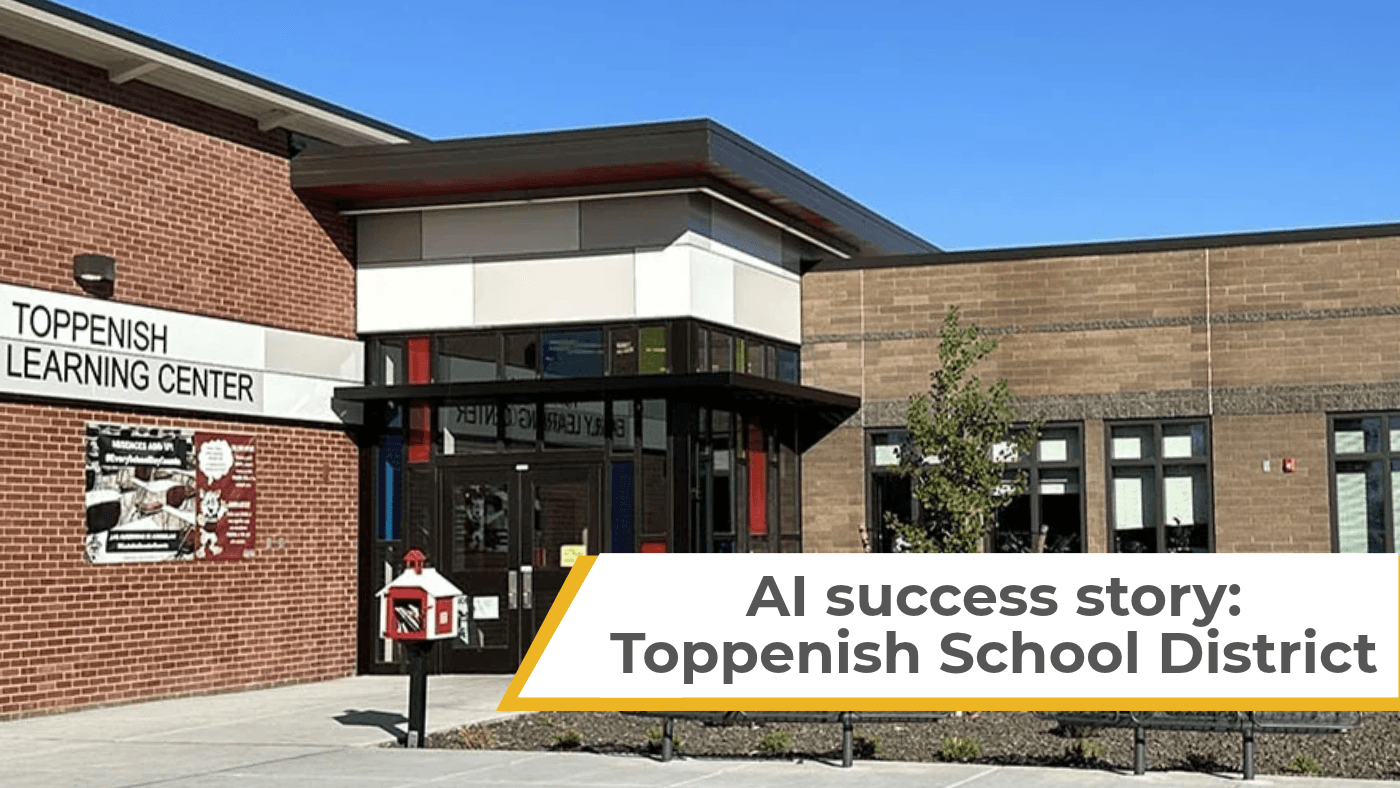
When data feels hard to reach, people stop looking. At Toppenish, one week with Connect AI was enough to change that.
When Dr. Cheantel Adams joined Toppenish School District a year ago, she stepped into a role that depends on getting the right data to the right people quickly. “It was so overwhelming, honestly,” she says of stepping into her role as Coordinator of Assessment and Accountability and Student Supports. At a meeting in October, she saw Homeroom for the first time and “loved it.” Back in her district, though, the response was a firm no.
Adams soon understood why. Many staff members had already tried Homeroom, struggled to navigate it, and moved on. Others “had just given up on Homeroom and it was dormant,” turning instead to the student information system — “which is harder than Homeroom.” Connect AI gave her a new way to reintroduce the platform, and the results showed up within a week.
Here is what Toppenish educators are gaining:
- Faster starts for principals: Building leaders got faster access to state assessment results, and generated more precise intervention groups and instructional plans.
- Weeks of work done in an hour: Initial screening for highly capable (HiCap/HCP) students that once required extra staff time and stipends now takes in a single meeting.
- A friendlier relationship with data: Staff who once avoided the data coordinator now see her as “a benefit and a help.”
- Use well beyond the classroom: High school staff, case managers, and even health clerks are finding their own uses for the platform.
Roll out AI with a gift, not a training manual
In August, Adams introduced Connect AI to Toppenish principals with a deliberately light touch. As someone who relies on data to support decisions all across the district, she knows that educators can feel defensive about what the data shows — so she framed the rollout as a present. “All I said was, I have a gift, use it. No background.” She explained what the district hoped Connect AI would do, then told principals, “go play with it and let me know what you think.” Many had already been experimenting with AI on their own, and she “knew that our principals were open to it.”
A week later, the results came back in a flood. “Every campus had a different need,” Adams says, and principals made the most of their freedom to explore the data. Among the first outputs produced were:
- Intervention groups built faster, with easy pulls of assessment data
- State assessment (SBA) results for each principal's own building
- Instructional plans shaped by what the data showed
“So in a matter of a week, our principals just took off,” Adams recalls. “And now we are spending time taking action and not digging and waiting for the data.”
Adams introduced Connect AI as a “gift” to her principals, then saw them get excited about unpacking it.
Make data less threatening, one conversation at a time
For Adams, building relationships is part of the rollout. When the data is easy to pull, “I can quickly go to someone’s office, we can get together in a meeting, pull up this data.” That responsiveness has changed how colleagues see her role, and she says they now see her “as a benefit and a help.”
One conversation captures the shift. A colleague who had been wary of Homeroom since a spring training asked to pull up her notes before looking at any data. Adams told her, “I promise you, you don’t need notes.” Then she showed her: “Three clicks, the data pulled up, and she was like, 'No, you are kidding me.'”
Sharing results across campuses is deepening that trust. Adams knows that the more data is shared across buildings and functions, the less it feels like a critique. “When we look at it collectively and we understand that we’re all in this together,” she says, “we’ll watch ourselves rise together.”
Spend time on decisions, not spreadsheets
Some of the biggest wins have come from work that used to consume staff time. When Adams arrived, Toppenish’s process for identifying highly capable students relied on “this huge Excel document.” Her reaction was immediate: “Y’all, this is not humanly possible. We can collect all this data, but I don’t really know how we’re picking good students.”
“An activity that used to take weeks of extra time and stipend money for our district… we did it in an hour.”In a recent HiCap program meeting, the team entered its categories and indicators into Connect AI instead. “A list generates so quickly,” Adams says, and from there the team can overlay the qualitative information it already collects. The time savings are hard to miss. “An activity that used to take them weeks of extra time” and accrue costs for teacher stipends — “we did it in an hour,” she marvels.
Adams has also been surprised by who is using Connect AI and what they are using it for:
- High school teams see “a huge big picture” of students who have been with the district since kindergarten or first grade.
- Case managers use it to find clear learning goals as well as areas where students excel.
- Health clerks gather class and field trip information that feeds into student health plans.
Grow champions to spread data use across campuses
Adams is intentional about how Connect AI spreads. “So many times we just buy something, give it, and we don’t really follow through,” she says, so she prefers to let staff explore on their own terms. She also draws on one of her favorite education books, Raving Fans, to identify colleagues who will share their Connect AI knowledge. “Those raving fans are giving it out to other people, and that’s a great start,” she says.
Her champions now include counselors, teachers, coaches, and principals, which means the effort no longer depends on Adams alone. As more people get engaged, she says, “we can create a large fire, and keep it burning” with continual data conversations.
Closing the gap between knowing and doing
For Adams, the real payoff of faster access goes beyond saving time. “When we strengthen our ability to look at the data, we also strengthen our ability to do effective teaching and instruction,” she says. She is quick to add that the numbers are only part of the picture: “The work that we do in our schools is more than numbers. We know that. Our kids are more than numbers.”
Looking ahead, she hopes Connect AI will bring the right information to educators before they ask for it, surfacing “not only the bright spots for the week, but the students who are of concern.” As she puts it, “If we can get it to be proactive with sharing the right information, we can more quickly take action.”
Want to see how Connect AI can help your principals, coaches, and teams spend less time digging for data and more time acting on it? Watch the full webinar replay, or request a personalized demo for your district.