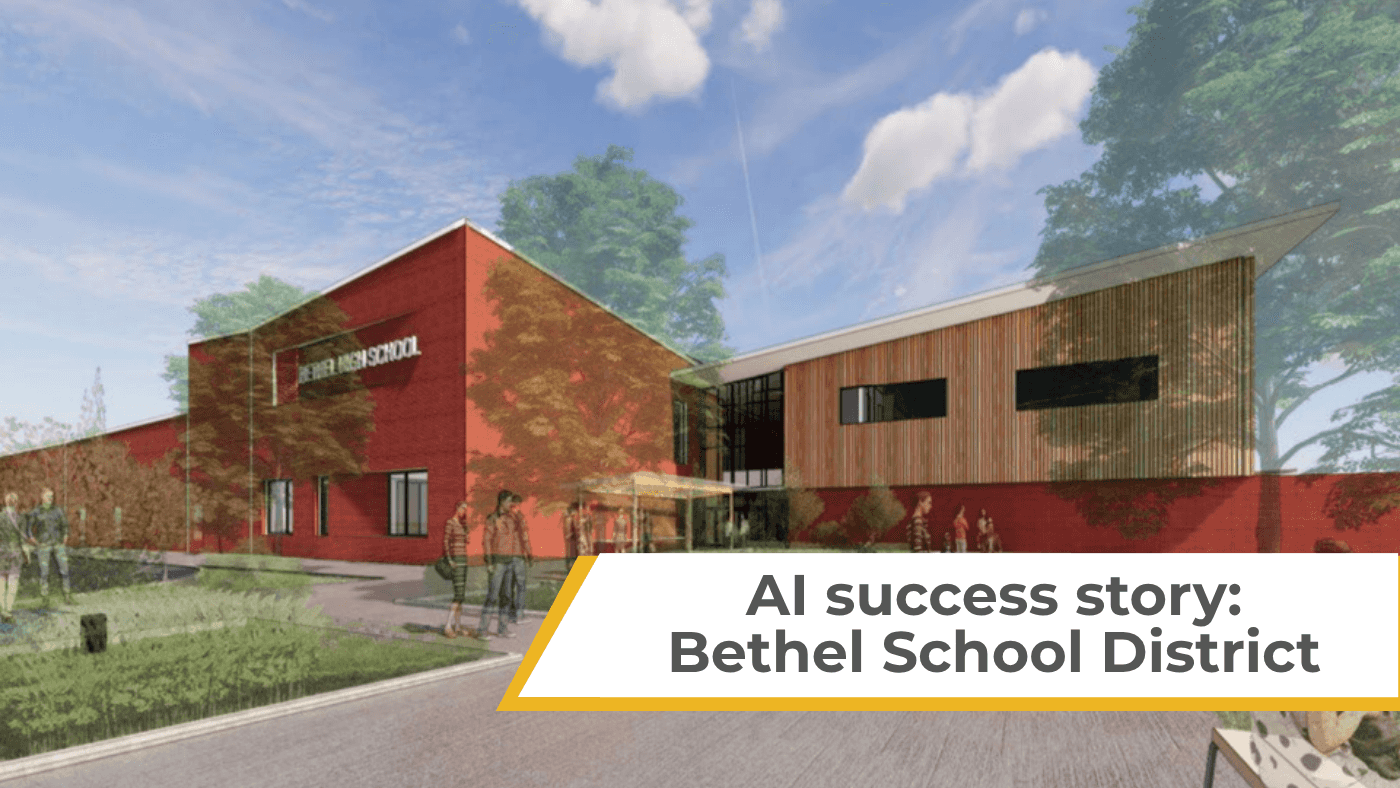
In just the first weeks of the school year, Bethel educators went from waiting on reports to asking their own questions — and acting on the answers.
As Director of Assessment and Highly Capable Programs at Washington’s Bethel School District, Brian Loffer has been a SchoolData user for more than a decade. Over that time, he noticed a pattern that many data leaders will recognize: dashboards and other data-intensive tools made perfect sense to people like him, who used them every day, but they weren’t intuitive for staff who logged in only occasionally.
Anytime an educator clocked an insight on a static dashboard, they immediately asked the next question — and that meant either a call to Loffer’s team or a customization that made the dashboard harder to read. Loffer saw Connect AI as the answer to both problems. Because it works like the AI assistants educators are already getting used to, educators were free to follow their own curiosity without a training manual or a request ticket. Loffer says, “I really liked the aspect of people engaging with their data.”
The results came quickly. In the previous school year, roughly 22% of Bethel’s users were accessing student data in SchoolData. Within the first week or two back to school, more than 50% were registering activity — and Loffer’s usage reports show the same people coming back again and again.
“I’m seeing my role change as more of a coach on how best to use the AI agent, as opposed to cranking out the data and sending reports and continually showing them how to navigate dashboards.”
— Brian Loffer, Director of Assessment and
Highly Capable Programs, Bethel School DistrictLead with results, then teach the tool
Like most districts, Bethel had only about 30 minutes of professional development time to introduce Connect AI to administrators in August. Rather than spend that time on clicks and menus, Loffer used Connect AI ahead of time to generate a school profile for every building, covering academics, attendance, and behavior. He shared the profiles at the August planning meeting and encouraged principals to validate the data presented in them.
Principals immediately started working with the data, using their profiles to adjust school improvement plans that typically aren’t finalized until October or November. Bethel’s superintendent, Loffer recalls, “made the observation that he’s never seen the administrators so focused and so targeted with their data in the past.” Many teams left that August meeting with solid drafts of their plans in hand. The next day, Loffer showed administrators how to create these profiles themselves in Connect AI.
From there, the rollout stayed deliberately light:
- Administrators first: Building leaders were trained to support their own staff.
- An open invitation: An all-staff email with a short video let early adopters get started on their own.
- AI before dashboards: Bethel launched Connect AI and updated Homeroom dashboards at the same time but pointed users to the AI. In Loffer’s words, “We would not be getting this increased amount of users if I had started with a whole new dashboard.”
Ask the next question in real time
Faster access has changed what happens in the room. During a recent administrator meeting about discipline, Loffer used Connect AI to pull a report on the spot. The analysis showed that a student’s school building was a bigger predictor of the consequence they received than their prior violations — an insight that put consistency at the center of the conversation. He notes that he “would never have been able to do that kind of thing in that kind of time frame before.”
Follow-up questions have proven just as valuable. When a fall illness left a wave of students flagged as chronically absent only four weeks into the year, staff asked Connect AI whether those students had also been chronically absent last year. That one question “helped us identify the kids who are a concern right now,” Loffer says. “When we add those prompts, Please provide key findings and next steps, it gets people thinking.” He is also adding the district’s strategic plan goals and behavior interventions as reference documents so Connect AI’s recommendations reflect Bethel’s own priorities.
Build systems, not just superusers
Loffer has found that educators fall into two broad groups with AI adoption. Some will explore and refine their questions on their own, while others want reassurance that a prompt will deliver quality results. To reach that second group, Bethel created data advisory teams of counselors and administrators at the elementary, middle, and high school levels. Each month, these teams build and refresh a short list of district prompts tied to current priorities.
The goal is to give principals, PLCs, grade-level teams, and counselors a shared starting point without limiting what anyone can ask. As Loffer explains, “It’s great if we have a few people that are really using it, but that’s not going to move the needle on student achievement unless we get the whole system moving.”
Trust built on security and human judgment
For district leaders still weighing how educators should use AI with student data, Loffer understands the hesitation. He was nervous about staff uploading student information to outside AI tools, and Connect AI was the first option that addressed those concerns. Given his long experience with SchoolData, he was reassured that Connect AI was “part of Homeroom and the secure server that we already had,” with role-based permissions that ensure staff see only the data they’re authorized to see. Loffer has seen Connect AI refuse to show staff members data from outside their building so “I can vouch that it works.”
He also emphasizes that AI doesn’t replace educator judgment. Staff are encouraged to validate results, understand what the data represents, and refine prompts when an answer misses the mark. Interestingly, Loffer has found that AI-generated reports can ease some of the defensiveness around data. When every principal sees every school’s profile, for example, it “takes the personal part out.” It becomes clear, Loffer says, that “we all have places to work on,” and the conversation shifts to shared areas of growth.
Momentum from day one
The biggest change in Bethel isn’t a single report — it’s who is asking the questions. Building teams and teacher teams, the people closest to students, are now accessing data and acting on it themselves. And with help from Connect AI to disaggregate attendance and behavior data and identify targeted student groups, Bethel already has intervention groups underway. “We’re actually way further than we’ve ever been four weeks in,” Loffer says.
Want to see how Connect AI can turn more of your staff into confident data users? Watch the full webinar replay, or request a personalized demo for your district.